North Flint Neighborhood Action Council Brings ‘Neighbor’ Back to Neighborhoods
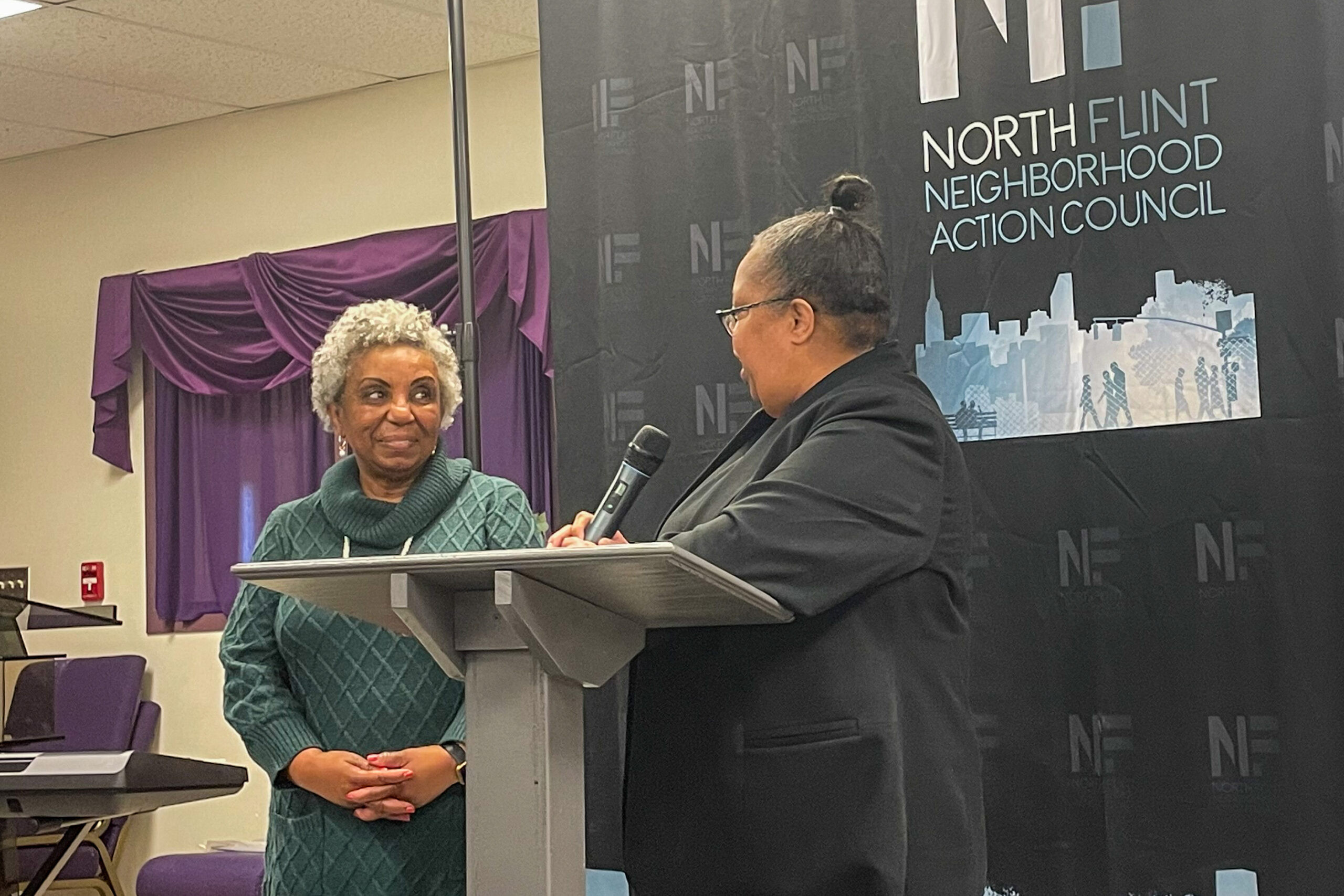
When Jeanette Edwards looks around her north Flint neighborhood with LED streetlights that illuminate the block or when she recalls summer porch gatherings where neighbors laugh, celebrate and enjoy their community or the many children who light up during her “Read All About It” reading program, she can’t help but feel proud.
“If it wasn’t for NAC, we wouldn’t know what to do,” she says. “We’d be at a standstill.”
Edwards, 70, has lived in Flint since she was 17 years old and now serves on the advisory board of the North Flint Neighborhood Action Council (NAC). She’s also a longtime leader of the Brownell/Holmes Neighborhood Association. When she joined the NAC years ago, she says, her neighborhood was struggling to find its footing. There was little knowledge about who to call for help, how to reach city officials, or where to find resources.
“We didn’t have nobody in north Flint teaching us how to reach out and talk to people,” she recalls. “Now we have meetings all the time, informative meetings, where you can learn about voting, safety, grants, and who to reach out to for help.”
That transformation — one built on education, connection, and empowerment is exactly what the NAC was designed to do.
“Somebody asked me once, ‘How does it feel knowing that without your help this wouldn’t have happened, but nobody here knows who you are?’” recalls Patrick McNeal, director of the North Flint Neighborhood Action Council. “And I told them, that’s the point. It’s not about me. It’s about the community.”
That philosophy lies at the heart of the Neighborhood Action Council, a resident-led initiative that has been quietly but powerfully reshaping how neighborhoods in Flint organize, advocate, and thrive.
 The NAC was born more than a decade ago through the federally funded Building Neighborhood Capacity Program, a national effort that selected just four cities, including Flint. From its inception, the NAC has been made up of residents and cross-sector partners working side by side to strengthen neighborhoods. Its mission is to help residents use data, develop and implement plans rooted in their concerns, secure resources, and carry out projects that matter most. The organizing principle has remained steady: address issues of safety, education, communication, housing, and beautification by bringing together block clubs, neighborhood associations, and organizations to enhance the quality of life for all.
The Ruth Mott Foundation supported the NAC at its inception and ever since federal funds ended about 10 years ago under its Neighborhoods priority area, understanding that north Flint residents voiced a need for strong neighborhoods.
“Too often, things were done to communities and not with them,” McNeal said. “Folks would parachute in, do their work, and leave. We wanted to change that. We believe in intensive listening, in going back to the community to confirm what we heard, in advocating for their needs, and in staying until conditions improve.”
That commitment has meant hosting dozens of listening sessions over the years — at least 75 so far — and supporting 10 to 15 block clubs and neighborhood associations at any given time. Out of those conversations, residents themselves have identified priorities and shaped programs that touch nearly every part of community life.
“With NAC, we have done so much as far as teaching people things, clean-ups, added lights, Ring doorbells and also things that they need to know about voting and who to reach out to, like the public officials, city officials and state officials,” said Edwards. “We didn’t know none of that.”
In the past year alone, NAC has expanded its work in civic engagement. It hosted two City of Flint Civic Youth Leadership Academies in collaboration with the Michigan League for Public Policy at the Accelerated Learning Academy, while also conducting a Civic Leadership Academy for adults. NAC members participated in poll monitoring and voter engagement efforts, receiving training from Promote the Vote and serving as poll challengers at more than 20 precincts across the city. They also carried out voter registration drives that pre-registered more than 500 students at Flint Southwestern, Accelerated Learning Academy, Hamady High School, and The New Standard. Civic engagement even became a feature of the neighborhood Porchfests, where residents combined music, food, and community connection with Get Out the Vote activities.
NAC has also deepened its work to assist neighborhood groups. In 2023, it launched an eight-hour Building Better Block Clubs training program, designed to help residents strengthen their leadership, organizational, and technical skills. “Block clubs are the backbone of neighborhood life,” Patrick says. “If they’re strong, the community is strong.”
Environmental justice and data-driven decision-making have also taken center stage. NAC received an EPA grant to advance well-being equity by conducting environmental asset mapping of green spaces. The idea is to increase residents’ sense of belonging, safety, and stability by highlighting and protecting the natural assets in their neighborhoods. The group also completed a Community Impact Measurement project with NeighborWorks America, collecting data that can be used to measure change over time and demonstrate progress to funders and policymakers.
 Through all of these efforts, NAC’s focus has broadened from traditional neighborhood improvement to include collective well-being, which McNeal defines through five key elements: connectedness, stability, safety, mattering, and access to relevant resources. That vision has led to initiatives like wellness circles for women in north Flint, collaborations with Hurley Medical Center and Sloan Museum to improve health and literacy access, and No Weapon, a program encouraging young people to rethink carrying firearms.
McNeal said people like Edwards have been instrumental in ensuring the NAC’s work reflects the lived experiences of residents. Residents like Edwards have helped lead neighborhood initiatives, strengthen block clubs, and connect the Council’s priorities to what families in north Flint say they need most. Their leadership, alongside McNeal’s, has kept the NAC rooted in its original promise: that residents themselves should drive change.
“Well-being is a set of needs and experiences everyone requires: connectedness, stability, safety, mattering, and relevant resources. These give people the chance to chart their own course and be bold,” McNeal says. “The village is better when everybody is doing what they need to do to thrive.”
For McNeal, the measure of success is not whether the NAC receives recognition but whether its work becomes unnecessary. “My ultimate goal,” he admits, “is to put myself out of business. Too many of us are paid based on the suffering of other people. I hope one day that suffering goes away — that communities are strong enough, connected enough, and empowered enough that they don’t need me.”
Until that day comes, the North Flint Neighborhood Action Council will keep listening, showing up, and putting the “neighbor” back in neighborhoods.
Or, as McNeal puts it: “Democracy only works when you work it. And in Flint, residents are proving every day that when they’re given the tools and a seat at the table, they can and will astonish you.”
Visit northflintnac.org to learn more.